The Bank of Japan (BoJ) published on 10 November the Summary of Opinions at its Monetary Policy Meeting of 29–30 October (BoJ, 2026a). At that meeting the Policy Board kept the policy rate at around 1.25% by an 8–1 vote; the dissenter, Takata Hajime, proposed around 1.5% (BoJ, 2026b). It was the first meeting after the rise from around 1.0% on 17–18 September (Yılmaz, 2026). The summary lists opinions without names, each submitted by a member and edited by the Governor (BoJ, 2026a, p. 1), so it shows the range of views, not who held them or how many members shared each.1
What was said after the rise falls into three groups. Two opinions give the case for waiting: more examination of risks and financial conditions, and time to assess the cumulative effects of past rises (p. 3). Others look to the next rise: one says the Bank should decide on it when possible without becoming overly cautious, one that the pace of moving towards the neutral rate should be stepped up, and one that the Bank should "make haste slowly", watching financial conditions for a few months after each rise (p. 4). A third group points the other way: one opinion notes that the policy rate has entered the estimated range of the neutral rate and that a further rise could weigh on the economy (pp. 4–5). Another puts the neutral rate considerably above 1% (p. 5). On prices, one opinion judges underlying inflation to be generally consistent with the 2% target, and several turn to keeping it anchored there (pp. 2–3).
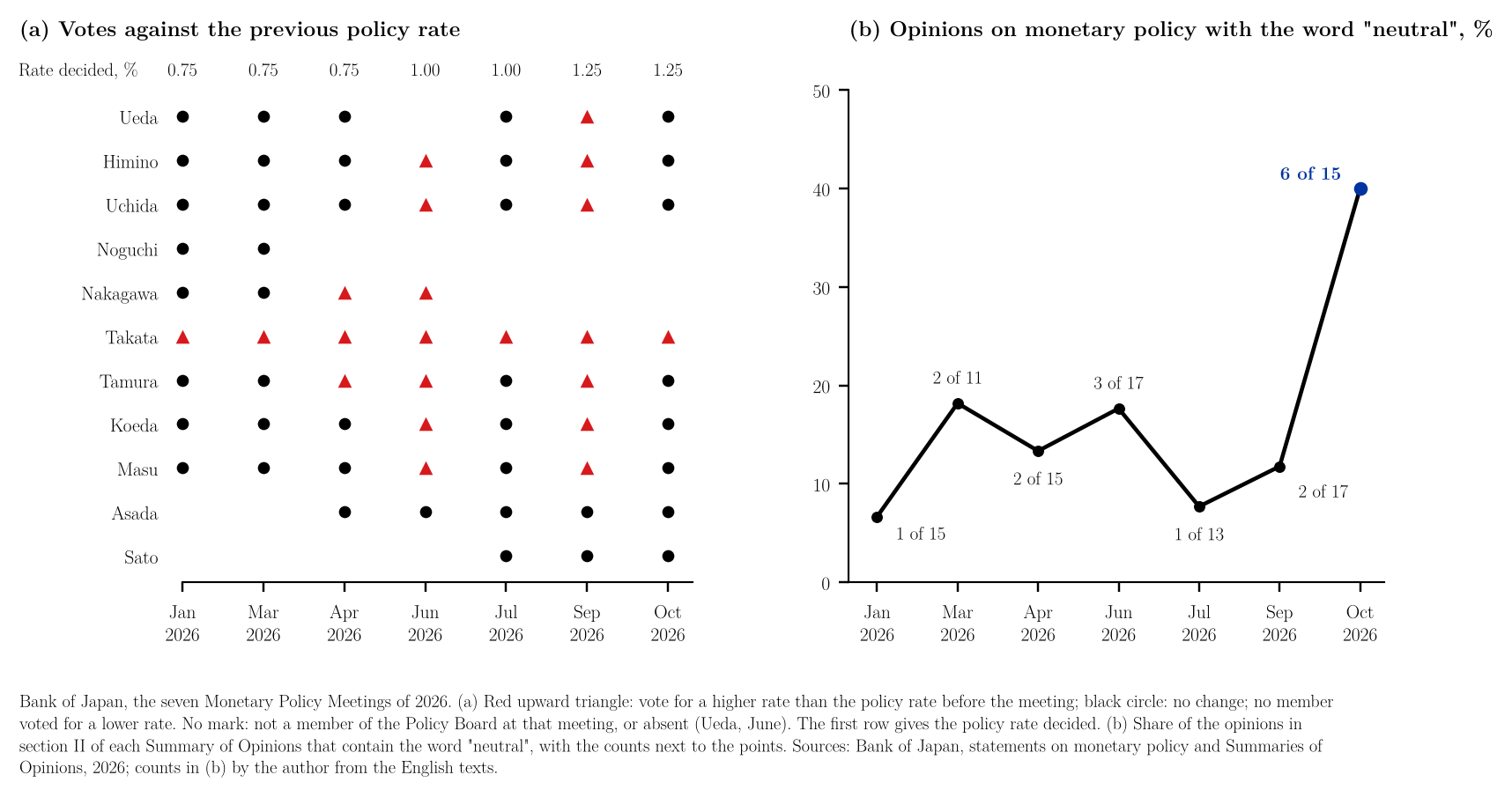
The votes of 2026 show the same division (Figure 1a). All seven decisions were by majority. At the five meetings that kept the rate, every dissent was for a higher rate: one vote in January, March, July and October, and three in April. At the two meetings that raised it, to around 1.0% in June and around 1.25% in September, every dissent was for no change: one vote and two (BoJ, 2026b, 2026c).2
The word "neutral" appears in 6 of the 15 opinions on monetary policy in the October summary, against 1 to 3 in each of the six earlier summaries of 2026 (Figure 1b). Forms of "anchor" appear six times in the sections on the economy, prices and monetary policy, against at most two before. In June an opinion placed the policy rate below the estimated range of the neutral rate (BoJ, 2026c); in October one places it inside. A word count is a crude measure: it does not say how many members hold a view, and one of the two uses in March refers to neutral financial conditions, not the neutral rate.3
The Board also decided unanimously to raise the pace of its sales of exchange-traded funds from about 330 billion to about 860 billion yen a year at book value, from January 2027 (BoJ, 2026b); two opinions support the change (p. 5). The minutes are due on 23 December. This note does not forecast the next decision.
References
Bank of Japan. (2026a, November 10). Summary of Opinions at the Monetary Policy Meeting on October 29 and 30, 2026. https://www.boj.or.jp/en/mopo/mpmsche_minu/opinion_2026/opi261030.pdf
Bank of Japan. (2026b, October 30). Statement on monetary policy. https://www.boj.or.jp/en/mopo/mpmdeci/mpr_2026/k261030a.pdf
Bank of Japan. (2026c). Statements on monetary policy, changes in the guideline for money market operations and Summaries of Opinions, January–September 2026. Retrieved November 10, 2026, from https://www.boj.or.jp/en/mopo/mpmdeci/state_2026/index.htm and https://www.boj.or.jp/en/mopo/mpmsche_minu/opinion_2026/index.htm
Yılmaz, M. İ. (2026, November 5). Bank of Japan, minutes of the 17–18 September 2026 meeting: A 7–2 vote to raise the policy rate to around 1.25%, with producer price inflation of 7–8% and exports picking up on AI-related demand. https://muhammedikbalyilmaz.com/posts/boj-minutes-september-2026.html
Notes
-
Page numbers refer to the Summary of Opinions (BoJ, 2026a). The opinions are paraphrased, except for the phrase quoted from p. 4. The English text is a translation prepared by the Bank's staff from the Japanese original (p. 1). The opinions of the government representatives (pp. 5–6) are not covered here. ↑
-
Votes, rates and the dissenters' proposals are from the statement published after each meeting; the address of each is in the file: votes (CSV). Nine members voted at every meeting except June, when one was absent. In April the three dissenters proposed around 1.0%; in June and September the dissenters considered it desirable to keep the previous guideline. ↑
-
Counts (author's). From the English text of each of the seven Summaries of Opinions of 2026: the number of opinions (bullet points) in each section, the number of opinions in section II, "Opinions on Monetary Policy", that contain the letters "neutral", and the number of times the letters "anchor" occur in sections I and II, in both cases without regard to capitals; the address of each summary is in the file: counts (CSV). October: $6/15 = 40\%$; the highest earlier share is $2/11 = 18\%$, in March. For October a second file lists the 34 opinions one by one, with section, page and three markers (contains "neutral"; says it is appropriate to maintain the rate at this meeting; mentions ETFs), without reproducing their text: October opinions (CSV). The counts for the earlier summaries cannot be recomputed from the file itself; they can be repeated from the documents with the rule above. The workbook lists every number in the note next to the formula that produces it and a check against the text, so that readers who wish to examine the calculations can follow and audit them in a spreadsheet without losing time and without running any code. The code that draws the figure and repeats the same calculations is available on request. ↑