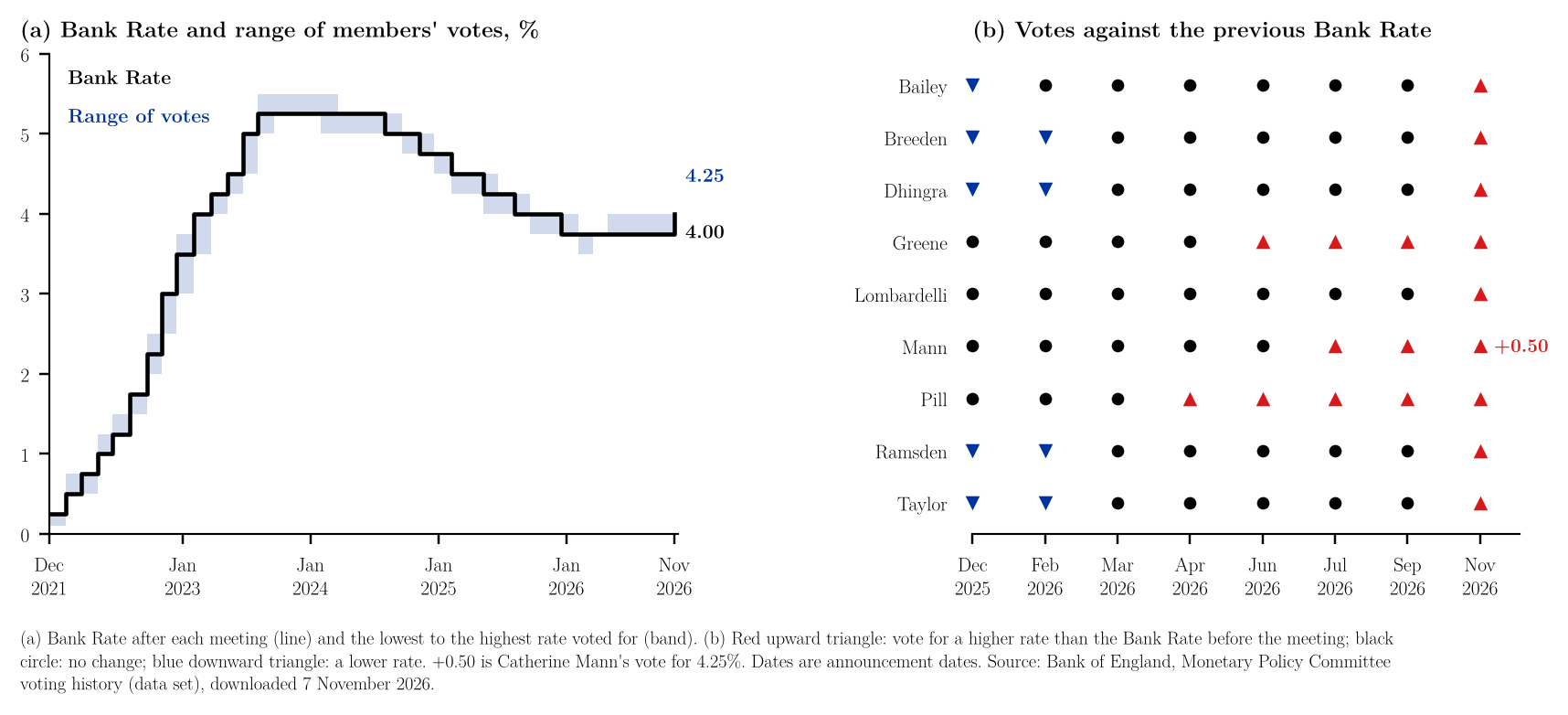
The Bank of England's Monetary Policy Committee (MPC) voted 8–1 at its meeting ending on 4 November to raise Bank Rate by 0.25 percentage points, from 3.75% to 4%; Bank Rate had been held at 3.75% in July and September (Bank of England, 2026a).1 Eight members voted for the 0.25-point increase and Catherine L. Mann for a 0.5-point increase, to 4.25%. The Committee also stated: "Monetary policy is not on a pre-set path." The next decision is due on 17 December.
CPI inflation was 3.5% in September, up 0.9 points from 2.6% in June (Bank of England, 2026a, 2026b).2 Direct energy effects account for about 1 point of the 3.5%. The staff projections have CPI inflation at about 4½% in the first quarter of 2027 and about 5% in the second, both higher than in the July Report. The 28 October budget lowers CPI inflation by about ¼ point by the second quarter of 2027.
The projections rest on energy prices that have risen since July. Over the 15 working days to 27 October, Brent crude was $108 a barrel and UK gas 216 pence a therm, 38% and 81% above the levels in the July Report; the Committee describes the Middle East conflict as being in its ninth month. The same shock is visible in euro-area producer prices, where energy prices were 30.8% higher in September than a year earlier (Yılmaz, 2026).
On second-round effects, the minutes see little sign of indirect effects so far, with many firms absorbing higher costs through their margins, but they judge that the risk of material second-round effects has risen since September. The minutes discuss three scenarios: a central one with larger second-round effects than in July, an adverse one with persistently higher energy prices and larger second-round effects, and one in which domestic demand weakens.
GDP grew 0.5% in the second quarter and is expected to have grown 0.7% in the third; unemployment was 4.7% in the three months to August and is projected at 4.8% in the fourth quarter. Two-year benchmark mortgage rates have risen by nearly 50 basis points since early September. In the Market Participants Survey, the median expectation for Bank Rate is 4% in November and 4.25% in February. Most members judged policy to be still restrictive, depending on the measure.
The Bank's voting history shows how the vote moved over the year (Bank of England, 2026c).3 No member voted for an increase in March; one did in April, two in June, three in July and in September, and all nine in November, the first meeting since November 2022 at which every member voted for an increase. Mann's vote for a 0.5-point rise is the first vote for a rise of that size since August 2023 (Figure 1).4
Members' stated views differ on what follows. Mann voted for a larger rise. Lombardelli saw a case for a further increase in the near term, and Greene said that additional increases will likely be required. Pill judged that a single 0.25-point rise was unlikely to be sufficient, while Taylor described his vote as an insurance increase. These are the members' own statements in the minutes; the note makes no forecast of the December decision.
References
Bank of England. (2026a, November 5). Monetary Policy Summary and minutes of the Monetary Policy Committee meeting on 4 November 2026. https://www.bankofengland.co.uk/monetary-policy-summary-and-minutes/2026/november-2026 (PDF: https://www.bankofengland.co.uk/-/media/boe/files/monetary-policy-summary-and-minutes/2026/monetary-policy-summary-and-minutes-november-2026.pdf)
Bank of England. (2026b, November 5). Monetary Policy Report – November 2026. https://www.bankofengland.co.uk/monetary-policy-report/2026/november-2026
Bank of England. (2026c). Monetary Policy Committee voting history (data set). Downloaded November 7, 2026, from https://www.bankofengland.co.uk/-/media/boe/files/monetary-policy-summary-and-minutes/mpcvoting.xlsx
Yılmaz, M. İ. (2026, November 7). Euro area industrial producer prices, September 2026: 11.1% on the year, the highest rate since February 2023, with energy at 30.8% and the rest of industry at 3.5%. https://muhammedikbalyilmaz.com/posts/euro-area-industrial-producer-prices-september-2026.html
Notes
-
The decision and the vote (Summary; minutes, paragraphs 19–22), the previous holds in July and September, the statement on the policy path, the date of the next decision (paragraph 24) and the members' views (paragraph 23) are from the Monetary Policy Summary and minutes (Bank of England, 2026a). The meeting ended on 4 November and the documents were published on 5 November. ↑
-
The CPI rates, the projections and the scenarios are from the Summary, minutes paragraphs 3, 4, 6, 7, 9, 14, 15 and 16, and the Monetary Policy Report (Bank of England, 2026a, 2026b). The June CPI rate, GDP growth and unemployment are from the Report; the projections are rounded as in the minutes ("around 4½%", "around 5%"). The figures used are in data (CSV) and the votes in data (CSV); every number in this note is calculated or checked with Excel formulas in the calculation workbook (Excel). Differences between a published rate and a rate recomputed from rounded figures can be a tenth. ↑
-
Bank of England, Monetary Policy Committee voting history, sheet "Bank Rate Decisions": the Bank Rate after each meeting and the rate each member voted for, December 2021 – November 2026, 40 meetings (Bank of England, 2026c). The dates in the source are the dates of the announcements (5 November 2026 for the meeting that ended on 4 November). The votes of the nine current members are in the right-hand columns of the votes file. ↑
-
Calculations (author's). A vote is "for an increase" when the rate voted for is above the Bank Rate before the meeting. "All members voted for an increase" means that the number of such votes equals the number of members voting at the meeting; the last earlier meeting for which this holds in the file is the one announced on 3 November 2022. The size of a vote for a rise is the highest rate voted for less the Bank Rate before the meeting: 0.5 points in November 2026 (4.25% against 3.75%); the last earlier meeting with a vote of 0.5 points or more is the one announced on 3 August 2023, and every meeting in between has a smaller gap. The comparisons are descriptive. ↑